
Haemonchus contortus - The Barber’s Pole Worm
Haemonchus contortus is a roundworm that affects sheep and goats, and to a lesser extent cattle. This blood-sucking roundworm produces eggs that are very similar in size and shape to those produced by other roundworms such as Ostertagia and Cooperia.
Indicators of Haemonchus contortus in a sheep include the presence of elevated faecal egg counts (e.g., > 5000 eggs per gram) and clinical signs including poor thrive, anaemia, general weakness, “bottle jaw” (swelling under the jaw), with little or no diarrhoea. However, given that larval stages may also consume blood, faecal egg counts may not always be elevated. It takes a relatively low number of worms to cause highly pathogenic disease, and adult animals develop little immunity meaning unlike some other parasitic infections adults too are at risk of developing disease. The usual cause of death is anaemia due to blood loss. Each adult worm can remove 0.05mls of blood from its host daily, so a burden of 2,000 worms can result of a daily blood loss of 100mls.
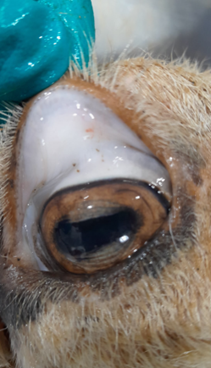
Image 1: Sheep showing severe anaemia
(with thanks to Athlone RVL)
Haemonchus contortus are prolific egg layers and can over winter in flocks through the persistence of larva in their dormant state within the host. Unfortunately, this feature also lends itself to development of anthelmintic resistance in this worm species, thus making resistance a common feature of flocks with this parasite.
A definitive diagnosis of Haemonchus contortus can be reached via postmortem examination when these roundworms, measuring up to 30mm, are observed in the abomasum (fourth stomach). In contrast to Haemonchus contortus, the maximum size of Ostertagia ostertagi roundworms, which are also located in the abomasum, is 10mm. An additional test that is offered by the parasitology laboratory in Backweston is the peanut agglutinin staining test, whereby Haemonchus eggs can be differentiated from other strongyle type eggs in faecal samples.
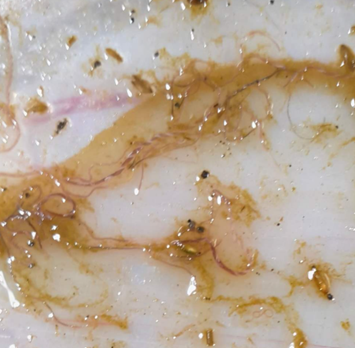
Image 2: Post mortem sample showing Haemonchus contortus with its typical barber pole appearance
(with thanks to Athlone RLV)
The perception from the Department labs is that Haemonchus contortus is increasing in Ireland and the geographic area it has been diagnosed in is expanding.
While the observed increase in the involvement of Haemonchus in mortalities investigated by RVL postmortems may indeed reflect an increased prevalence, some part of the increased numbers may be a result of heightened awareness of the disease as a cause of illness especially weight loss and anaemia in sheep (in particular), especially through the monthly reports of RVL findings in the Irish Veterinary Journal.
In recent weeks, cases of haemonchosis seen by the RVL’s have decreased in number, however this is thought to be due to the long spell of hot dry weather seen recently. Once rain begins again these parasites will most likely reactivate leading to increase disease risk.
For further information please see scops.org.uk/internal-parasites/worms/haemonchus-contortus/.
If you have concerns about Haemonchus contortus in your flock, please talk to your private veterinary practitioner about prevention and control.